
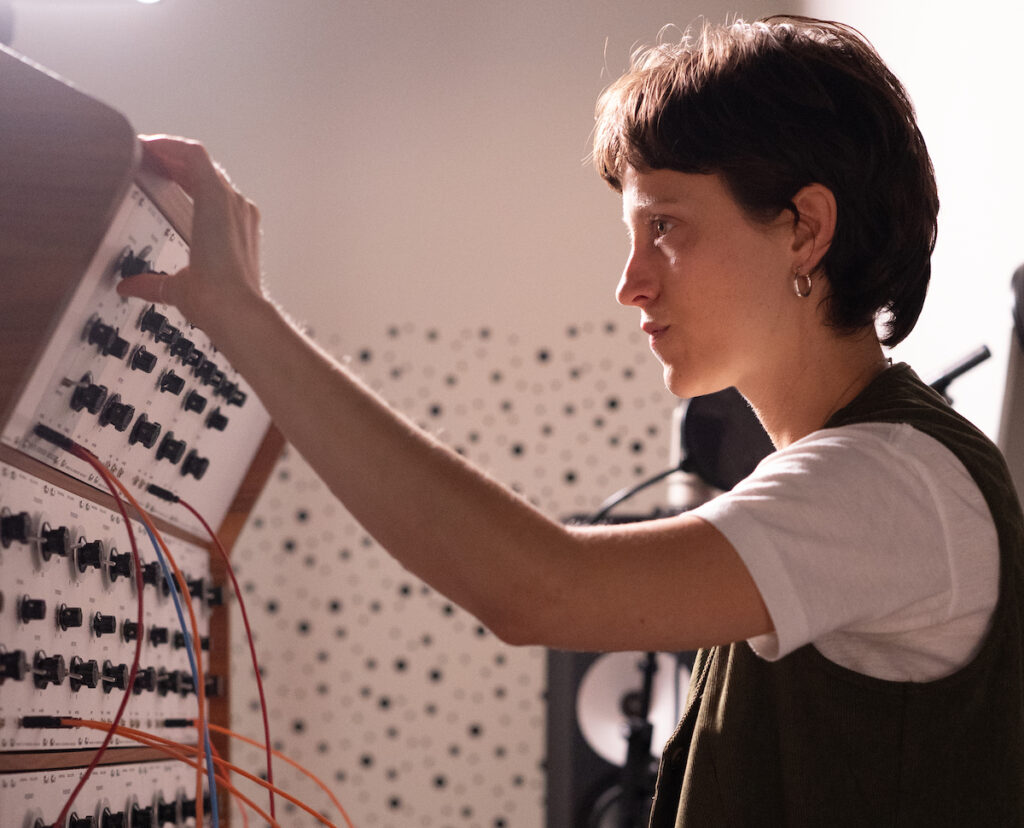
Author: Diane Barbé
I remember playing, as a child, a game called “Who made that sound?”. One would be blindfolded in the centre of a group of other children, and after being given a few spins for confusion, all kids would go quiet, giggling softly. Then someone, spontaneously, would voice out a strange sound—a bark, a howl, a growl, a squeak, a whistle. Generally, we’d hide our human identity under the guise of an animal voice, as if there was an unspoken rule that the sound should pertain to more-than-human realms. Upon hearing it, the person in the centre had to point to the origin of the sound and try to guess who made the sound. It was often strangely accurate, especially if we knew each other well. Even if the imitation was good and the bark sounded quite close to a “real” bark, there was always a very fine detail, an elusive hint hidden in the grain of that voice that told us who was really behind the masquerade.
This particular ability to recognise a “who” behind a sound reaches beyond the context of this game and opens wider questions about cognition and signification in the sonic realm. We could wonder what it is in a voice or in the listener’s experience that makes it possible to accurately identify a source for that sound. For now, let’s explore places where imitations may actually work, where our listening references are blurred, queered, mirrored, when we don’t know for sure what or whom we are hearing.
A Sonic Need to Imitate
In electronic music, we can find many examples of sounds that try to convince us that we are hearing something for something else. Imitations of soundscapes of birds, insects, as well as geophonic events like rain and wind are present in all kinds of productions but are seldom discussed. The pieces cited here come from a personal lens into western contemporary music and certainly should welcome additional references. Some may paint fake landscapes in the background, like the recurring patterns of waves created by electronic musician Suzanne Ciani in many of her albums and live performances with modulated white noise, like in her 1982 release Seven Waves or in the stormy atmosphere that takes over the final section of “A New Day” in her more recent collaboration with Kaitlyn Aurelia Smith Sunergy. In discussing these albums with a fellow musician, Serge Nasr, he pointed out that fakeness in music does not bother us as strongly as in visual contents: “How could you really know that Ciani’s waves are not real waves?” he asked. “You’d never be completely sure…” The rolling waves of white noise wash over us and evoke the ocean like a poetic allegory, and their sound is “close enough” without needing to conform to a completely realistic acoustic depiction of a particular beach.
In a more distorted way, the “Themes” in Rashad Becker’s Traditional Music of a Notional Species Vol. I also evoke encounters with sickly beings, whose repetitive yet constantly evolving vocalisations hold patterns we may know from listening to live choirs of amphibians or insects. It is difficult to know what obscure FM and digital processes were used here by Becker to produce these utterances, but somehow there is a kind of life in them, as if we could discern a mouth, bowel, or organ that generates them and helps them become disturbingly animated.
Another recurring trope of sonic mimicry with synthesis is that of the “electronic birds,” where an oscillator or a resonant filter is modulated with pulses and cyclical patterns. In Cochin Moon, an early solo album written by Haruomi Hosono as the soundtrack to an non-existent Bollywood film, the introduction feature a strange moment reminiscent of a warm, humid night under tropical climates, with electronic birds, proto-crickets, fake cicadas, and other nocturnal critters surrounding us before the theme song begins. Recently, the Slovakian label Mappa released the compilation Synthetic Bird Music, featuring over 30 contributions that recreate dreams and memories of interactions with birds, an amalgam of many different techniques from live instrumentation to analog synthesis. The liner notes explain that the pieces “[simulate] the qualities of bird sounds, hitting similar frequential sweet spots”, but ask us to listen to them beyond musicality, in their capacity to deplore the impacts of human activity on the biosphere and the imminent mass extinction.
Not the Voice of Nature
What is interesting is that these imitations are not about a baroque depiction of idyllic “nature,” a romantic wilderness which escapes us and therefore can implicitly justify the desire to dominate, rationalise, and exploit it. Rather they begin to acknowledge the omnipresent construction of nature and the responsibility to care and act now. In sonic imitation, there is potential to slide into a sonic fiction that yields a different kind of agency, that does not try to re-present the “sounds of nature” and brings us to challenge established categories of meaning and identity in the nature-culture continuum. Imitations, simply put, can’t and won’t reproduce “the voice of nature”, and neither do recordings. A conversation between experimental musicians Luc Ferrari and François-Bernard Mâche, who were both part of the Parisian Groupe de Recherches Musicales in the early 1970s, underlines the tension around sound reproduction. Discussing his piece Presque Rien, which is based on a very subtle recomposition of field recordings taken at dawn in a Mediterranean village, Ferrari explains that he preferred to work with concrete sounds to “reproduce the qualities of nature”, rather than try to re-enact them with orchestral scores. Mâche cheekily responds that he understands this attraction to the beauty of the “real” sonorous world, but points out an important paradox where the devices used to record and play back these sounds are still mediators in the process, and that in the end, “we are already in the artifact, so in the art: we are beyond realism, so in a kind of surrealism”. Rather than reproduction, therefore, it is useful to think through distorted mirrors even though recordings may appear like perfect replicas. In the etymology of “record,” we find the Latin recordari “remember, call to mind, think over, be mindful of,” from the prefix re- that evokes the sense of “restoring, and cor which means ‘“heart’”. Recording therefore implies learning by heart, the metaphoric seat of memory; by extension, recording becomes an act of taking something –a sound– into our heart with such care that we can accurately reproduce it, which eventually is a form of imitation. And I would playfully suggest that a reproduction given by a pair of microphones, a media engraving, and a set of amplified speakers, is not necessarily more accurate than a whistler in love.
Make-believe games require attention, intimate knowledge, application, and effort; they demand that we engage in specific and lengthy relations if we want the mimicry to work. In Listening After Nature, Mark Peter Wright discusses the capacity of foley as an artform and a method to disrupt established codes: “Unsettling the master narrative that equates truth and knowledge as part of the same natural bag, Foley delinks the two and produces epistemic disobedience”. While foley is a term conventionally used for sound effects in the film industry, we could certainly describe fake electronic soundscapes as foley. What foley and mimicry can offer is a space of possibility to step away from the demand for hyper-realism: these examples of musical imitation have no pretence of veracity, but rest on an enormous and careful work by the mimic to observe, repeat, practice, and refine their mimetic practice. Perhaps they are trying to make a synthesiser sound alive—not like the perfect copy of a real bird but reaching toward it, practicing imitation and shapeshifting, working on the minute details that make something become animated or magical. This creates an aural situation where musicians and listeners alike are being asked to step out of the realistic and into the surreal.
Human-Non-Human Voices
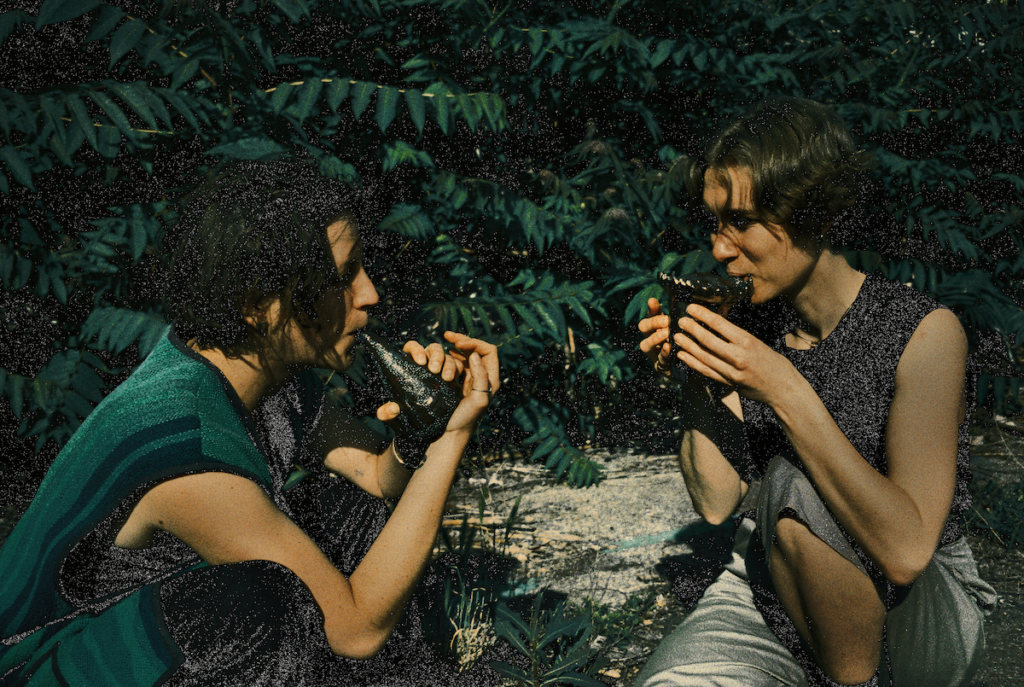
Have a listen, for instance, at Joan La Barbara’s 1976 piece Les Oiseaux qui chantent dans ma tête, or Ute Wassermann’s “trill territory” on her 2022 album Birdtalking. We are strangely good at recognising humanness in their voices, although La Barbara and Wassermann draw out a kind of uncanny valley of their own, offering a listening experience at the limits of what we usually know as a human voice and leaning toward a non-human expression. The distinction is more subtle with whistling, where imitators can utter nightingales, warblers, wrens, seagulls with incredible speed and pitch precision. Bird whistlers were popular street and concert performers in the US and western Europe in the early 20th century. Some of them even became household names, such as “Bird Man” Percy Edwards, Sibyl Anderson Fagan, or Charles Kellogg; an archive of recordings was compiled and reissued in 2015 by Canary Records as Wingless and Ecstatic: Bird-Imitation on Four Continents, ca. 1910-44. Professional musicians, foley artists, whistlers, and other kinds of hobbyists perform imitations all the time, and of course it is a very early and very important part of child play, pointing to how embedded in social life this process is. Ian Nagoski, the curator of Canary Records, points out in the liner notes of the Wingless release that sonic mimicry is an ancient practice that may have originated from hunting techniques where whistling or calls were used to attract game “probably pre-dating anything resembling music or language.” It is difficult to know at what point these practices became a form of entertainment, of play, of non-verbal communication, perhaps of devotion, and eventually how much of the practices of song and language emerged from it.
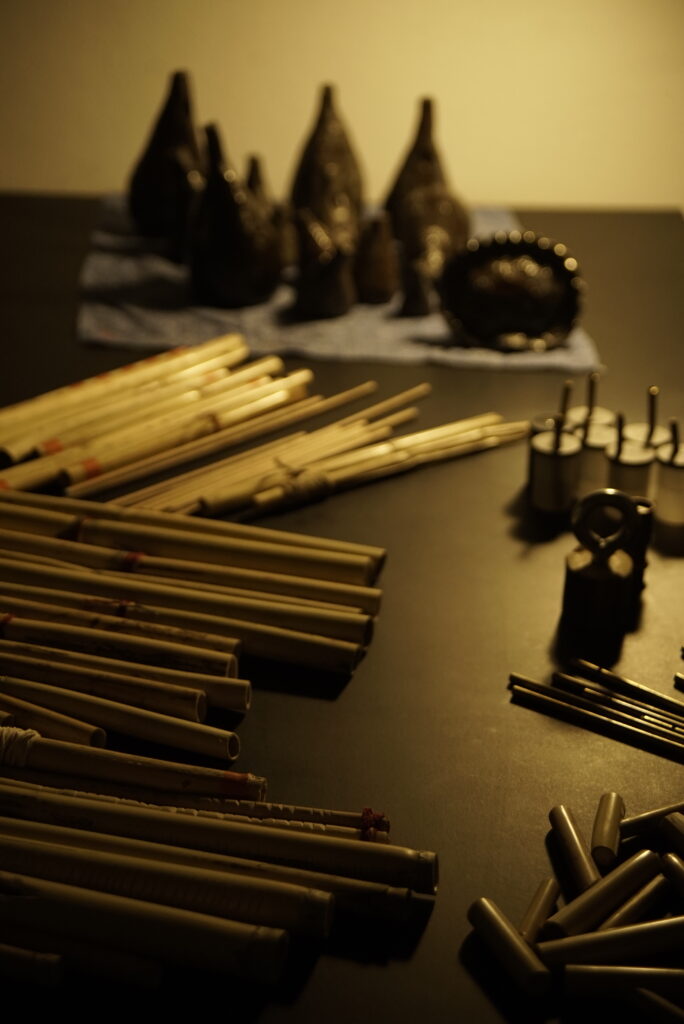
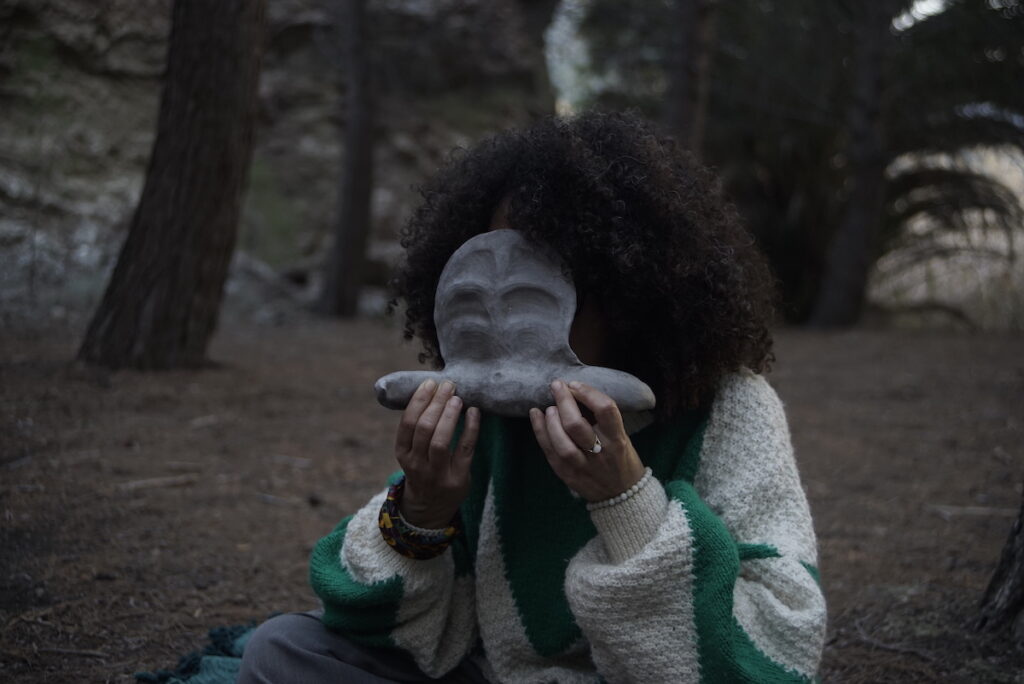
Many different kinds of instruments have been built to imitate birdsong as well as other animal vocalisations. From whistling jars to bone flutes, serinettes, and automatas, as well as game calls of all kinds, there is a long and worldwide interest in creating instruments that can help transform our human voices into something else, or rather someone else. In fact, there are debates in archaeology about flutes from over 30,000 years ago, found in caves in central Europe and in the Iberic peninsula, that may have been whistles to imitate or call deer. Yet much of the research in anthropology and archaeology seems to miss an important point as sonic mimicry and call instruments are often described as an “attempt to replicate the sounds birds make”. Thinking about them as replicas again leaves out their potential for play, for learning, for getting to know the other voice so well that we can imitate it, for loving that sound so much that we want to respond to it.
We know of many beings, from coral reef fish to stick insects and moths, who are expert mimics both visually and sonically, and whose performances have adapted very quickly to changes in their perceptual worlds. Lyre birds can, for instance, imitate other birds with incredible detail and also echo anthropogenic noises that surround them, like chainsaws and camera shutters—an example made popular in David Attenborough’s BBC Earth documentary. During the dreadful bushfires of the winter 2019-2020 in Australia, magpies also reminded us that their repertoire mirrors the current ecological era by imitating the sounds of sirens that resonated all over their biotopes. These echoes are iterated by sentient beings who voice their version of a story, helping us think through resonance and imitation, and these practices are fertile to cultivate on our side as well, whether we are making music or simply listening.
About the author:
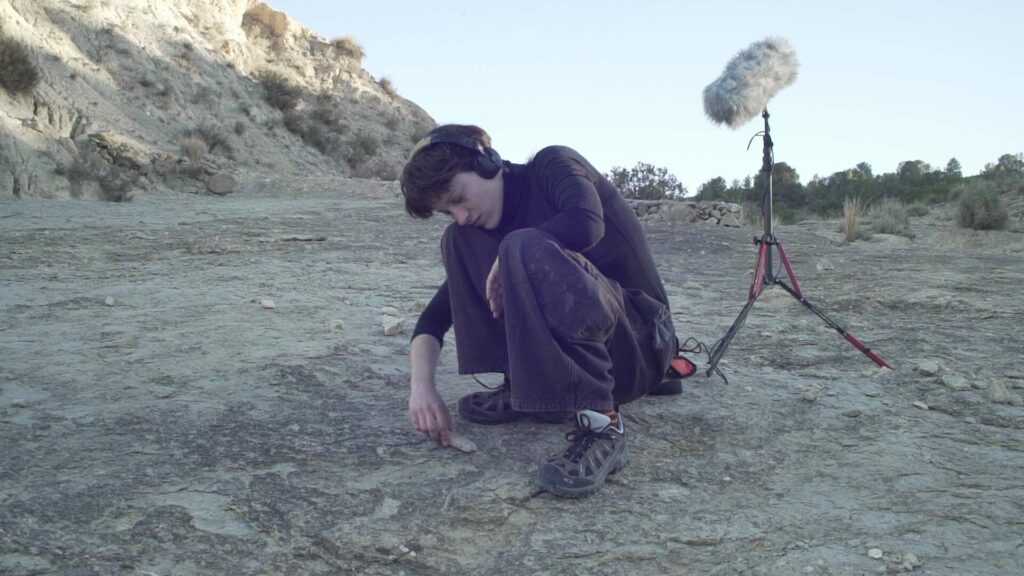
Diane Barbé (she/they) works at the intersection of experimental music and anthropology, delving into multiple practices of sound from instrument building, sound installations, electroacoustic composition, field recording, teaching and writing. Her ongoing project The Alien Kin develops music ensembles with handmade wind and percussion instruments, exploring imitation and sonic mimicry as possibilities for accessing more-than-human modes of representation. Her last album Musiques Tourbes (forms of minutiae, 2024) unravels a mixture of field recordings and additive analog synthesis, building together a swampy universe of small critters. Diane collaborates with Laure Boer on the radical improvisation duo Arbore and is part of the experimental quatuor Feu Fou. She has also performed solo in experimental music festivals and venues across Europe, has produced soundtracks for films and documentaries, and recently composed Signe Singe, an electroacoustic piece entirely based on foley commissioned by the GRM for their acousmonium in Paris.